Showing posts with label urbanization. Show all posts

Monday, May 21, 2012

Scratch that.

Calculated Risk posts that this is the fourth consecutive months with a year-over-year increase in miles driven.


The lack of growth in miles driven over the last 4+ years is probably due to a combination of factors: the great recession and the lingering effects, the high price of gasoline - and the aging of the overall population. 
I had suspected earlier that the "driving stagnation" could be attributed to structural payoffs in urbanization - i.e. people don't have to drive so much to get where they want to go. I had not thought about the impact of an aging population. Nevertheless, I don't actually think that gasoline prices are a cause. It'll be a fascinating trend to follow.

Thursday, May 17, 2012

Deurbanization was a leading cause of the Dark Ages


Pretty cool comment from user on Reddit (all sourced, and everything):
The Medieval Warming Period that started in the 900s and the discovery of new crops in the New World in the 1500s increased Europe agriculture capacity. This led to more urban living and education which led to the development of new agriculture technologies and even more dense populations (return of urban civilization like Rome). 
The bubonic plague happened in the 1300s which screwed up Europe's economy for a temporary 150 years and in the 1400s you got the Gutenberg Printing Press which lead to 20 million copies of books being printed by 1500 spreading literacy to the masses. 
It took 150 years for Europe's population to recover.  
The Medieval Warm Period, the period from 10th century to about the 14th century in Europe... 
This protection from famine allowed Europe's population to increase, despite the famine in 1315 This increased population contributed to the founding of new towns and an increase in industrial and economic activity during the period.  
A lot can be said about the rise in power of Western Europe once it collected itself from the collapse of the Roman Empire but I dont want to make this too long.
He was refuting the idea that the Catholic Church was behind the European Dark Ages.

The logic actually makes a lot of sense. I wonder if the initial gains from urbanization were greater than the gains now. Is there a diminishing marginal benefit for every person that enters a city?

Wednesday, May 9, 2012

Was Aristotle a governmental Malthusian?

"Experience shows that a very populous city can rarely, if ever, be well goverened. To the size of states there is a limit, as there is to other things (plants, animals, implements), for none of these retain their natural power when they are too large or too small." 
Aristotle (322 B.C.) 
This quote was posted on the top of a report from the Indian Census on population density.

It seems that he believes jurisdictions that are ungovernable if they grow too large.

Tuesday, April 10, 2012

Why some states do better than others

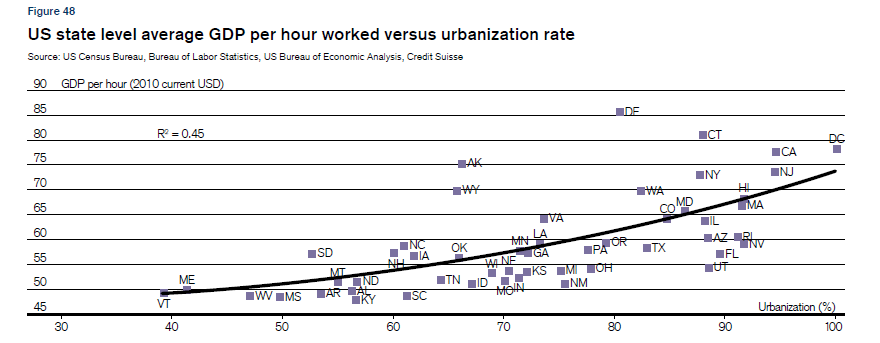
Alex Taborrok from Marginal Revolution posted yesterday about current trends in urbanization (a topic very near and dear to my heart) and was surprised by the strong correlation between GDP and urbanization rates as shown below (sorry for the bad formatting - had to make it big enough):


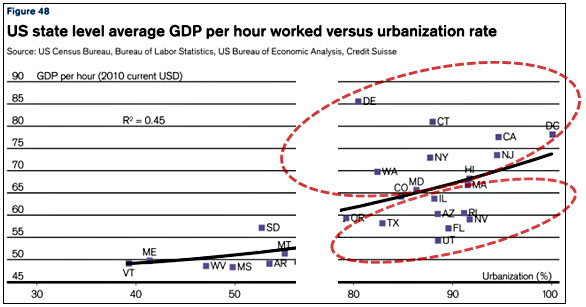
Kevin Drum from Mother Jones elaborated on some of this and Ryan Avents question: Why do some states have such large differences in GDP per hour but similar urbanization rates? (See graph below)


Drum pulled a conclusion from the original Credit Suisse report and wrote the following:
States that promote social mobility, discourage excessive income inequality, and are willing to invest in broad-based infrastructure, do well. Those that don't, don't.
But that's a pretty general cross-comparison to make. For many developing countries, urbanization has only been accelerating in the last 10 years, as compared to more developed countries that have been on a steady state of urbanization for decades. Such huge influxes of people have left many cities unable to support their populations, and therefore unable to tap into larger GDPs.

So it's hard to draw conclusions between U.S. states and countries when they have such different urbanization patterns. Time matters.

As to an answer why some states have higher GDP than others - it's a much more difficult question to answer. I think there we'll see many southern states continue to see their GDP rise as a result of population growth, but it's hard to say how effective their developing urban institutions will be.