Showing posts with label development. Show all posts

Tuesday, April 10, 2012

Why some states do better than others

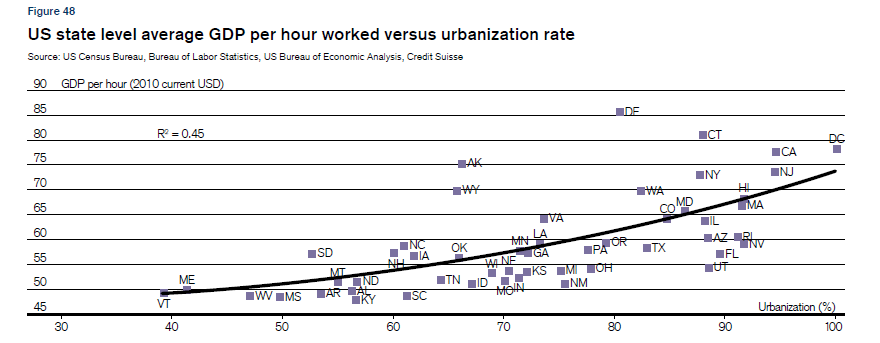
Alex Taborrok from Marginal Revolution posted yesterday about current trends in urbanization (a topic very near and dear to my heart) and was surprised by the strong correlation between GDP and urbanization rates as shown below (sorry for the bad formatting - had to make it big enough):


Kevin Drum from Mother Jones elaborated on some of this and Ryan Avents question: Why do some states have such large differences in GDP per hour but similar urbanization rates? (See graph below)
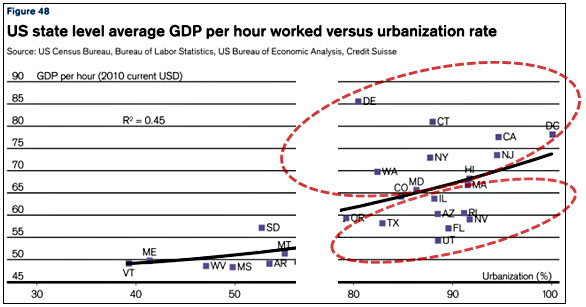

Drum pulled a conclusion from the original Credit Suisse report and wrote the following:
States that promote social mobility, discourage excessive income inequality, and are willing to invest in broad-based infrastructure, do well. Those that don't, don't.
But that's a pretty general cross-comparison to make. For many developing countries, urbanization has only been accelerating in the last 10 years, as compared to more developed countries that have been on a steady state of urbanization for decades. Such huge influxes of people have left many cities unable to support their populations, and therefore unable to tap into larger GDPs.

So it's hard to draw conclusions between U.S. states and countries when they have such different urbanization patterns. Time matters.

As to an answer why some states have higher GDP than others - it's a much more difficult question to answer. I think there we'll see many southern states continue to see their GDP rise as a result of population growth, but it's hard to say how effective their developing urban institutions will be.

Monday, April 9, 2012

The "Big Push" and Institutions

From Why Nations Fail:
One thing that all of these theories had in common— and, digressing again a little bit, one thing they share with several current theories of economic development — was that they were only about economics. Politics and institutions didn’t matter; only “economic fundamentals” mattered. The ones Rosenstein-Rodan emphasized were how much a society saved and how much foreign aid they got (which in the 1950s and 1960s was assumed to simply add to capital accumulation).
Here is the Big Push on Wikipedia.


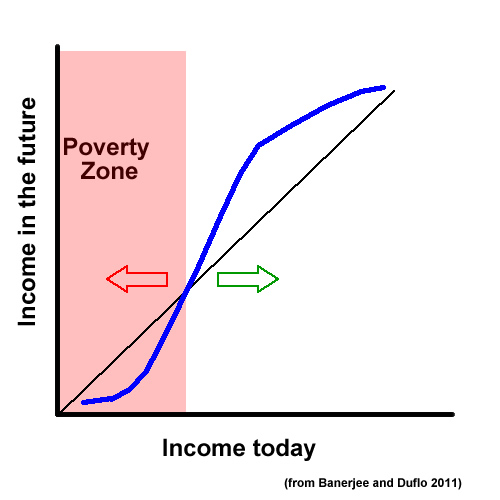
Big Push theory postulates that one firm's decision to modernize is dependent on other firms decision to do so, and that these firms will not modernize without a minimum amount of initial capital. (In other words - it's kind of like a poverty trap for firms.) 


This graphs provide a good demonstration:
As you can see, this "S-curve" shows that in order to attain higher income in the future, there is a steep incline signifying the need for large initial investments. Of course, the ideas behind the Big Push theory isn't widely agreed upon and needs more robust analysis. 

Daron Acemoglu and James Robinson's article is saying that the Big Push theory doesn't account for political or institutional barriers, which are especially important in developing countries where the large initial investments would be allocated. 

More links: