Showing posts with label social websites. Show all posts

Monday, June 25, 2012

Lock-In at Silicon Valley

Bill Davidow from The Atlantic has a great post on the new business model that defines many giants in Silicon Valley:
Facebook is a perfect example. You can spend a lot of time and energy learning the ins and outs of the site, and building your image on the site by posting pictures, videos, and messages. You spend a lot of time getting friends to pay attention to you, and you in turn spend a lot of time keeping track of them. If you leave Facebook, you leave both your virtual friends and your investment in the site behind.
The so called "lock-in" strategy that is pursued by Google, Twitter, Facebook, and others, is building an internet consumer culture that is limited by choice, and punished for pursuing other outlets.

You definitely see this happening in a number of places. Davidow points out that when it comes to listening to music - Apple blocks you in with it's technology (iPhones, iPads, iPods) and its software (iTunes).

But I think when it comes to social networking sites - something more is happening than an effective business strategy.

Let's look at Google+ and Facebook.

I wouldn't argue that the failure of Google+ is because of policies by Facebook. Google+ wasn't super successful because of the very nature of social media sites. Consumers want to tap into their network of friends, and the tighter and more interconnected their network is, the better. That's how Facebook beat out MySpace in the first place. We have a whole generation of people (of which I'm included) who literally can't be on the computer for more than 10 minutes without checking Facebook. And you know why? Because it's the closest thing we having to being a room with all your friends. You have a birds eye view of your entire social life That is pretty remarkable. 

It's kind of like this. I have a core group of friends. We hang out. We do things together. You get the picture. Isn't there a lock-in strategy there? It's more of a pain to explore new friends and social circles because you have to completely rebuild those friendships.

You could infer the same thing about Facebook, and other big internet companies. So why would we (as consumers) even lift a finger to look for substitutes, when it's all right there! 


I'm not saying that these companies actively pursue ways of keeping us on their websites, but it seems like a lot of the work is already done for them.  

Monday, April 30, 2012

Micro 101 Lesson: The Price System Matters

I wanted to add a little more from yesterday's post on Venture Capital.

The New York Times had an interesting piece about how a lot of start-ups (at least in the social media/Internet market) aren't generating revenue and would like to keep it that way.
When small start-ups I’ve spoken with do make money, they often find it difficult to recruit additional investment because most venture capitalists — and often the entrepreneurs they finance — are not interested in building viable long-term businesses. Rather, they’re interested in pumping up enough hype and valuation to find a quick exit through an acquisition at an eye-popping premium.
The full article is here.

This is a very interesting trend. Here are a bunch of start-up companies with a bunch of investors waiting in line to fund them. And the entrepreneurs are trying to avoid concrete results, and focusing on speculative growth. The article used one obvious example. Instagram has $0 in revenue, but sold for $1 billion.

I think this pattern, in particular, will be a key cause of bubble growth (and bust) in this industry. One of the first things I learned in my Micro 101 class is the importance of the price system. Revenues are pretty good signaling devices for producers and investors. They show how valuable a good is to a consumer. No one really knows how much the big social websites (Facebook, Twitter, Google+, etc.) are valued by users, because they're all free!

This means that it's difficult for investors to know whether all these new start-ups are going to do well. Is there ever perfect information and predictability in a company? Of course not. But if the price of lead tennis balls was $0 - you would expect that investors would avoid investing in lead tennis ball factories. The only problem is that there's no way to tell which start-ups are making lead tennis balls and which are making the next Facebook.

I'm sure there has been more in-depth research on this. But the main point is that we should be wary of investments that aren't based off of much information.


Sunday, April 29, 2012

Winklevoss Twins have equity in Facebook

Thought that was a pretty funny thing to hear in this interview.

They're also getting involved in the Venture Capital frenzy, investing in early-stage cloud companies.


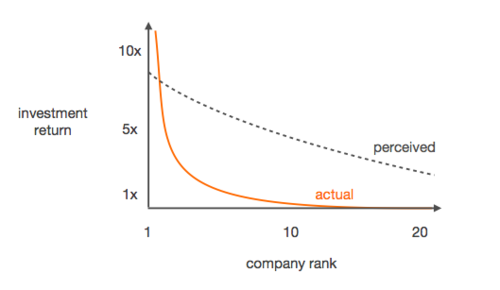
In all seriousness though, the idea of VC has been going around the blogosphere a lot. Peter Thiel gave a talk about how VC funds work. And showed this graph:
The basic principle is that for a VC fund, there are maybe one or two projects that actually make gains. A vast majority of the projects that are invested in tend to fail. . . I hope that this is something that VC managers (cough Winklevoss Twins cough) realize. Because it plays a big part in how the VC market works. 


Particularly, I wanted to point out Noah Smith's post about a slump in VC returns since the burst of the Dot-com bubble. He references a paper that shows this graph:
The different lines are different data sets showing how well VC funds did relative to Private Market Equivalence (or how well the U.S. public stocks did in general). A PME of greater than 1 means that the VC investment did better than public stocks. If VC's fell below 1, then investors would for sure leave the market.

As you can see, we're in kind of a VC slump. Where gains haven't reached anywhere near the levels reached in the mid-1990s. Of course, there could be a number of reasons why that is.

Maybe the VC fund's of the 1990s got all the low-hanging fruit. That doesn't really seem to surprise me. There really hasn't been any HUGE payoffs from the internet apart from what we already have. Yes, we have social networks, but are they really driving that much economic value other than advertisements? It seems to me that Venture Capital does well when there are big breakthroughs in a certain industry, and there's a vacuum with how to apply those discoveries. In fact, in 2011, less than 30% of VC funds went to software and media industries, and more are going towards energy and biotechnologies. These are trends that I'm glad to see - considering payoffs might actually improve living standards a good deal. It'd be interesting to see what Tyler Cowen thinks in relation to his Great Stagnation theory. 

But overall, I think the problem is that we haven't found some breakthrough way to apply big data or cloud computing. Hopefully these investments will help spur some of those discoveries...

Monday, April 23, 2012

Some thoughts on modern journalism

This post is going to be very different from what I'm used to writing. But it's something that I've been thinking about (but has probably been elaborated on somewhere else).

I used to intern for Charlottesville Tomorrow, which is a non-profit news organization that reports on local politics, transportation, and community design issues in the Charlottesville area. For such a small organization (now three full-time employees, and one intern), it does some very impressive things when it comes to local journalism. For one - they manage an online wiki for all things Charlottesville, that contains user-generated information on everything from candidate bios and transportation projects to local restaurants and show venues. They engage with readers through Facebook and Twitter to get more involved in local affairs. And they often invest in visualizations of big transportation projects, so that citizens understand what's happening in their community.

Towards the end of my time there, I did a bit of reflecting on organizations like Charlottesville Tomorrow and the current state of journalism. Many people are lamenting over the dwindling budgets of professional media outlets as more and more people get their news from blogs, social websites, or other "informal" news outlets. It's a product of the information age! Today we get information from everywhere! Why wouldn't you expect the information specialists to go out of business?

Well I would argue that journalists are probably as important today as they've ever been - provided that they adopt a few new skills.

While we live in the age of information, some would say that we live in information overload. A lot of people haven't developed an effective way to sort through what's important and cast away what is just hollow ramblings on the internet. One important aspect of this is in the world of data. Open Data has been growing considerably since the Obama Administration started an initiative soon after taking office. "Big data" provides us with such valuable information, and has so many untapped opportunities.

And yet, in our lifetime, most of us will not (either through lack of time or lack of ability) interact with this open data movement, or use for our benefits. How would anyone even know where to begin?

This is where modern day journalists can come in. There is still a need for specialists to decipher and find important pieces of information for wider society, but it could be that finding those conclusions are just harder to find. Journalists' research can't just be confined to interviews, they have to dive into databases and other sources of "hidden information." Journalists need to start behaving like public researchers, and less like pundits. 

And that's the basic idea. I'd love to hear other thoughts on this, though.

Monday, April 9, 2012

Thoughts on Facebook (pre-IPO)

This could be expanded. There's something to be said about how social media websites function as firms and the nature of their outputs.

Some general observations: 
  • Facebook's "product" (access to the social network) is only as valuable as the number of users. And each user has his or her own unique social group. So in a bizarre way, the product is fine tuned to very specific interconnected sub-markets

  • There is a far amount written about Facebook's app economy. Some is here and here. Facebook is spending less on R&D, relying on outside developers. In the second link, it says Facebook is mimicking Apple's R&D model. The payoffs may not be as valuable for a company that is not producing replicable goods.

  • The new products that analysts keep talking about never actually leave the website. All new innovations (thus far) have remained on the profiles. Is there a diminishing marginal return for this pattern?
Overall it will be an interesting year for Facebook. There will be plenty of IPO analysis to go around, and I'm sure many anxious investors will it's much more valuable than it actually is. 

Here is the full S-1 S.E.C. registration form.