Showing posts with label Facebook. Show all posts

Monday, June 25, 2012

Lock-In at Silicon Valley

Bill Davidow from The Atlantic has a great post on the new business model that defines many giants in Silicon Valley:
Facebook is a perfect example. You can spend a lot of time and energy learning the ins and outs of the site, and building your image on the site by posting pictures, videos, and messages. You spend a lot of time getting friends to pay attention to you, and you in turn spend a lot of time keeping track of them. If you leave Facebook, you leave both your virtual friends and your investment in the site behind.
The so called "lock-in" strategy that is pursued by Google, Twitter, Facebook, and others, is building an internet consumer culture that is limited by choice, and punished for pursuing other outlets.

You definitely see this happening in a number of places. Davidow points out that when it comes to listening to music - Apple blocks you in with it's technology (iPhones, iPads, iPods) and its software (iTunes).

But I think when it comes to social networking sites - something more is happening than an effective business strategy.

Let's look at Google+ and Facebook.

I wouldn't argue that the failure of Google+ is because of policies by Facebook. Google+ wasn't super successful because of the very nature of social media sites. Consumers want to tap into their network of friends, and the tighter and more interconnected their network is, the better. That's how Facebook beat out MySpace in the first place. We have a whole generation of people (of which I'm included) who literally can't be on the computer for more than 10 minutes without checking Facebook. And you know why? Because it's the closest thing we having to being a room with all your friends. You have a birds eye view of your entire social life That is pretty remarkable. 

It's kind of like this. I have a core group of friends. We hang out. We do things together. You get the picture. Isn't there a lock-in strategy there? It's more of a pain to explore new friends and social circles because you have to completely rebuild those friendships.

You could infer the same thing about Facebook, and other big internet companies. So why would we (as consumers) even lift a finger to look for substitutes, when it's all right there! 


I'm not saying that these companies actively pursue ways of keeping us on their websites, but it seems like a lot of the work is already done for them.  

Thursday, May 17, 2012

Chris Dixon on the Facebook Business Model

Now that final's season is over - I'm trying to dive back into daily blogging.

Chris Dixon has a great post on Facebook's business IPO that I think complements some points I was making in a previous post (albeit much more clearly):
The key question when trying to value Facebook’s stock is: can they find another business model that generates significantly more revenue per user without hurting the user experience? (And can they do that in an increasingly mobile world where display ads have been even less effective.) 
Here is the link.

Chris is certainly right that Facebook has a lot of resources to use if it's going to alter its business model. When Google+ was first coming out, I remember some people talking about the prospects of inserting a search engine into Facebook (probably using Bing). If Facebook is going to stick with display ads, they should shift their "social lock-in" strategy to include consumer habits - which involves expanding Facebook beyond purely social interactions.

Sunday, April 29, 2012

Winklevoss Twins have equity in Facebook

Thought that was a pretty funny thing to hear in this interview.

They're also getting involved in the Venture Capital frenzy, investing in early-stage cloud companies.


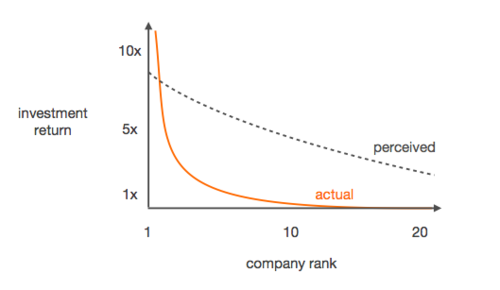
In all seriousness though, the idea of VC has been going around the blogosphere a lot. Peter Thiel gave a talk about how VC funds work. And showed this graph:
The basic principle is that for a VC fund, there are maybe one or two projects that actually make gains. A vast majority of the projects that are invested in tend to fail. . . I hope that this is something that VC managers (cough Winklevoss Twins cough) realize. Because it plays a big part in how the VC market works. 


Particularly, I wanted to point out Noah Smith's post about a slump in VC returns since the burst of the Dot-com bubble. He references a paper that shows this graph:
The different lines are different data sets showing how well VC funds did relative to Private Market Equivalence (or how well the U.S. public stocks did in general). A PME of greater than 1 means that the VC investment did better than public stocks. If VC's fell below 1, then investors would for sure leave the market.

As you can see, we're in kind of a VC slump. Where gains haven't reached anywhere near the levels reached in the mid-1990s. Of course, there could be a number of reasons why that is.

Maybe the VC fund's of the 1990s got all the low-hanging fruit. That doesn't really seem to surprise me. There really hasn't been any HUGE payoffs from the internet apart from what we already have. Yes, we have social networks, but are they really driving that much economic value other than advertisements? It seems to me that Venture Capital does well when there are big breakthroughs in a certain industry, and there's a vacuum with how to apply those discoveries. In fact, in 2011, less than 30% of VC funds went to software and media industries, and more are going towards energy and biotechnologies. These are trends that I'm glad to see - considering payoffs might actually improve living standards a good deal. It'd be interesting to see what Tyler Cowen thinks in relation to his Great Stagnation theory. 

But overall, I think the problem is that we haven't found some breakthrough way to apply big data or cloud computing. Hopefully these investments will help spur some of those discoveries...

Monday, April 9, 2012

Facebook followup

Following yesterday's post...


From The Guardian:

Social network giant Facebook has bought Instagram – a profitless, two-year-old photo sharing website – for $1bn. 
Instagram is a mobile sensation that counts Twitter co-founder Jack Dorsey among its backers. It has been downloaded by over 30 million people. When the Silicon Valley startup released a version for Android phone users this month, it was downloaded a million times in its first 12 hours.
Though Zukerburg mentioned that these kinds of acquisitions weren't likely to continue, that seems difficult to believe since Facebook's spending reports shows low R&D costs, implying a reliance on individuals to improve Facebook's quality.

So isn't there incentive for "social entrepreneurs" to create the next Instagram and sell it for high profits? And isn't there large payoffs for investors to finance them? 


Not that it's necessary for analysts to flip out over one buyout, but it could be a situation where everyone wants to sell to the big rich giant. And this certainly isn't helping the Silicon Vally bubble debates. 


Thoughts on Facebook (pre-IPO)

This could be expanded. There's something to be said about how social media websites function as firms and the nature of their outputs.

Some general observations: 
  • Facebook's "product" (access to the social network) is only as valuable as the number of users. And each user has his or her own unique social group. So in a bizarre way, the product is fine tuned to very specific interconnected sub-markets

  • There is a far amount written about Facebook's app economy. Some is here and here. Facebook is spending less on R&D, relying on outside developers. In the second link, it says Facebook is mimicking Apple's R&D model. The payoffs may not be as valuable for a company that is not producing replicable goods.

  • The new products that analysts keep talking about never actually leave the website. All new innovations (thus far) have remained on the profiles. Is there a diminishing marginal return for this pattern?
Overall it will be an interesting year for Facebook. There will be plenty of IPO analysis to go around, and I'm sure many anxious investors will it's much more valuable than it actually is. 

Here is the full S-1 S.E.C. registration form.